01
SmartSafety
Transforming Risk Assessment & Product Safety

About
As a Product Designer at Edelweiss Connect, I led the design of SmartSafety, a cloud platform built to help risk assessors simplify complex safety data and automate regulatory reporting.
Some details of this project remain confidential, but I’d be glad to share more about the process and insights in person.
Role
Design Lead
Client
Edelweiss Connect GmbH
Team
Product Designer (me), Developer, AI/Data Scientist.
Risk assessors and external experts providing iterative feedback
Timeline
From August 2024 until October 2025
The following personal skills were implemented during this project:
Product & Workflow design
Ethnographic reserach
UX/UI Design
Data Analysis
Information Architecture
Marketing & Business
Context

Edelweiss Connect operates in the biotech industry, developing cutting-edge digital solutions for pharma and research clients.
SmartSafety was one of its most innovative products, there were few market references, so we started from scratch.

Goal
The goal was to build a platform that helps risk assessors work faster, more simply, and all in one place:
a unified environment where data, calculations, and reports come together, agilized by AI to automate routine tasks and support better decisions.
Design Research

Literature Review
We followed a participatory approach, involving experienced risk assessors from the start. Their feedback helped us refine the platform continuously.
Through countless conversations and testing sessions, we realized that building a risk assessment formula felt a lot like creating an invoice as a repetitive, structured process that could be made far simpler with the right tools.
That moment sparked what we called a "service remix": borrowing the clarity and flow of familiar systems like invoicing to redesign a process that had long felt tedious and fragmented.
Most importantly, we came to understand what risk assessors really struggle with day to day, and how thoughtful design could make their work faster, lighter, and a bit more human.
01
Data scattered
across multiple internal and external sources (ingredients, formulas, contaminants to regulatory studies, etc)
02
Complex calculations
such as Margin of Safety (MOS) requiring manual inputs and research in many data bases
03
Evolving Global Regulations
(EU, US MoCRA, China CSAR) creating compliance pressure
Identified Opportunity Areas


Design Process
Our process moved quickly from mapping to making. We began by co-creating early workflow drafts with the team
Conducted qualitative interviews and conversations with women from diverse backgrounds, including those in menopause, perimenopause, and postmenopause. Explored experiences with symptoms, care-seeking journeys, and personal coping strategies.
Similarly, qualitative interviews were conducted with experts from different fields like OBGYN's, general doctors, design experts, experts in the menopause healthcare industry, etc.
Held participatory sessions to explore needs, test early ideas, and co-create meaningful solutions with women and healthcare professionals. These workshops highlighted emotional needs, education gaps, and the importance of family communication.
Analyzed user-generated content from Facebook groups and menopause forums to capture unfiltered experiences, frustrations, and shared coping mechanisms—surfacing patterns and recurring unmet needs.
Once the structure felt right, we jumped straight into Figma, turning those maps into interactive prototypes that we tested and refined in close collaboration with risk assessors.
Key Challenges
Physical symptoms often trigger emotional and social consequences, compounding stress and isolation.
Women frequently report being dismissed by doctors and forced to visit multiple providers to be taken seriously.
Many women lack understanding and emotional support from partners or family, increasing feelings of loneliness and frustration.
Together, these experiences show that menopause is not just a medical event—it’s an emotional, social, and systemic challenge. Women aren’t just managing symptoms; they’re navigating dismissal, disconnection, and silence.
This insight made clear that support tools must go beyond clinical advice—they must foster empathy, self-understanding, and communication in every part of a woman’s life.

Outcome
To address the challenges identified in the research, I designed a toolkit that empowers, educates, and connects.

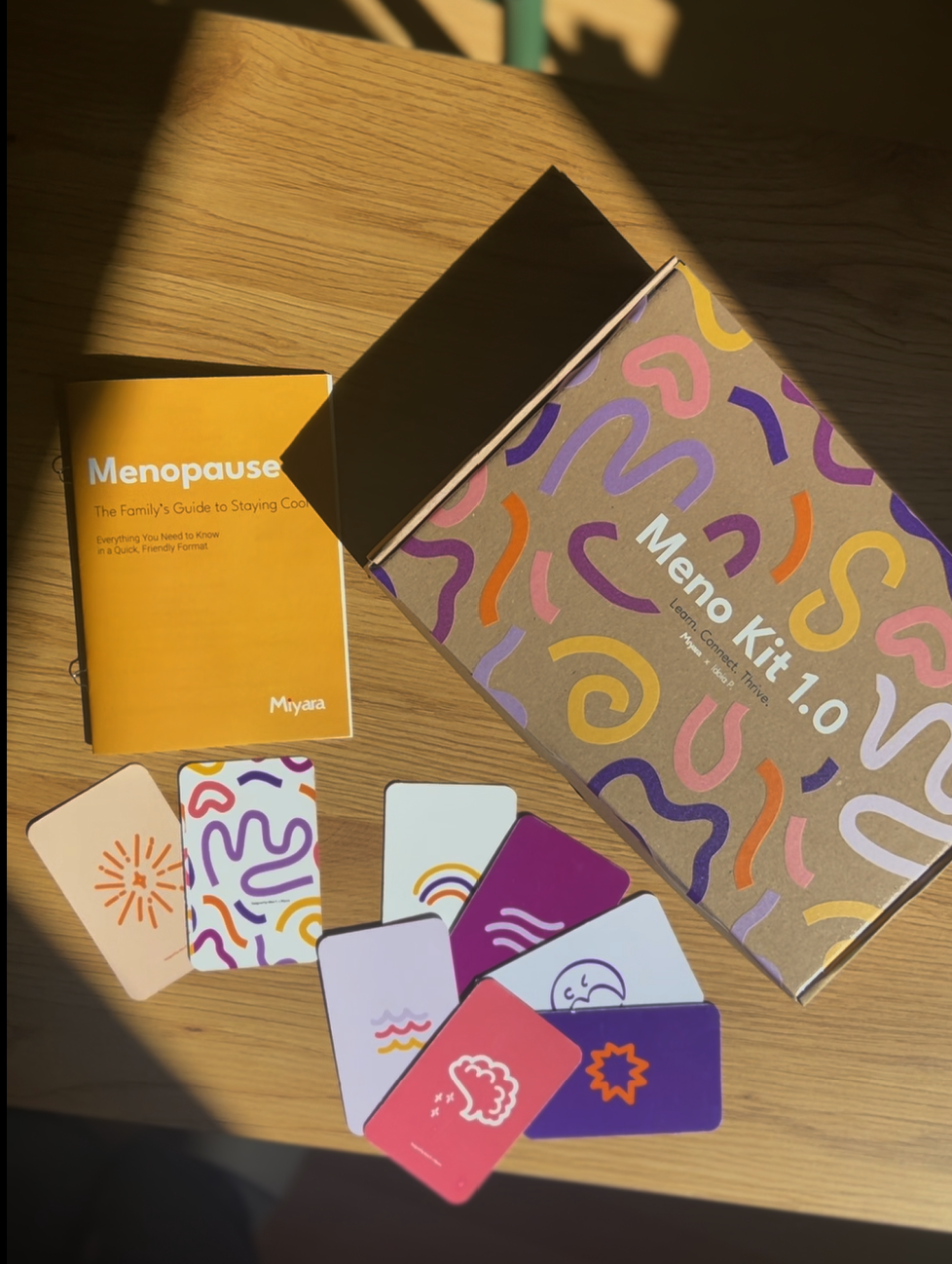
The Meno Kit 1.0
Developed in collaboration with Miyara Health, the Meno Kit 1.0 is the result of the synthesized insights gathered throughout this study.
It is a first-generation toolkit designed to support women and their families through menopause by promoting self-reflection, connection, education, preparation, and stronger support networks.
Let's explore the content of this toolkit below!
2. Cards — Physical Interaction Touchpoint 1
These cards are a key part of the Meno Kit, designed to encourage self-awareness, emotional grounding, and open dialogue. Each prompt is rooted in real stories and needs identified during research, covering themes like identity, self-compassion, empowerment, and communication.
The set includes two types of cards:
These cards offer self-guided support rooted in real challenges women shared during research. Designed for everyday use, they help build emotional resilience, manage symptoms, and shift perspective.
The set includes:
-
Cognitive Framing – Quick CBT-based prompts for anxiety, sleep, and hot flushes.
-
Empowerment & Self-Compassion – Reflections to nurture confidence and kindness.
-
Mindful Moments – Simple exercises to reconnect with the body and calm the mind.
-
Wild Cards – Bold, playful reminders to embrace your power—yes, even in a hot flush.
-
Embrace the Change – Prompts to reframe menopause with positivity and presence.
-
In-the-Moment Coping – Handy tools for managing tough moments as they happen.
Each card invites women to pause, reflect, or take action, making space for strength, humor, and self-care in everyday life.
-
Including the Meno Conversations and Connect & Support bundles, made to foster honest conversations with partners, friends, or family.
One example from the Meno Conversations set addresses sex and intimacy—a topic women frequently mentioned in interviews and online spaces but found extremely hard to talk about.
Many shared fears of hurting their partners or even facing divorce due to changes in intimacy. These cards may help open up that conversation: "Perhaps this is a very important topic to discuss with your loved one, isn’t it?"
All cards are flexible and can be used solo or shared—designed to make space for empathy, clarity, and connection during a stage that is often faced in silence.

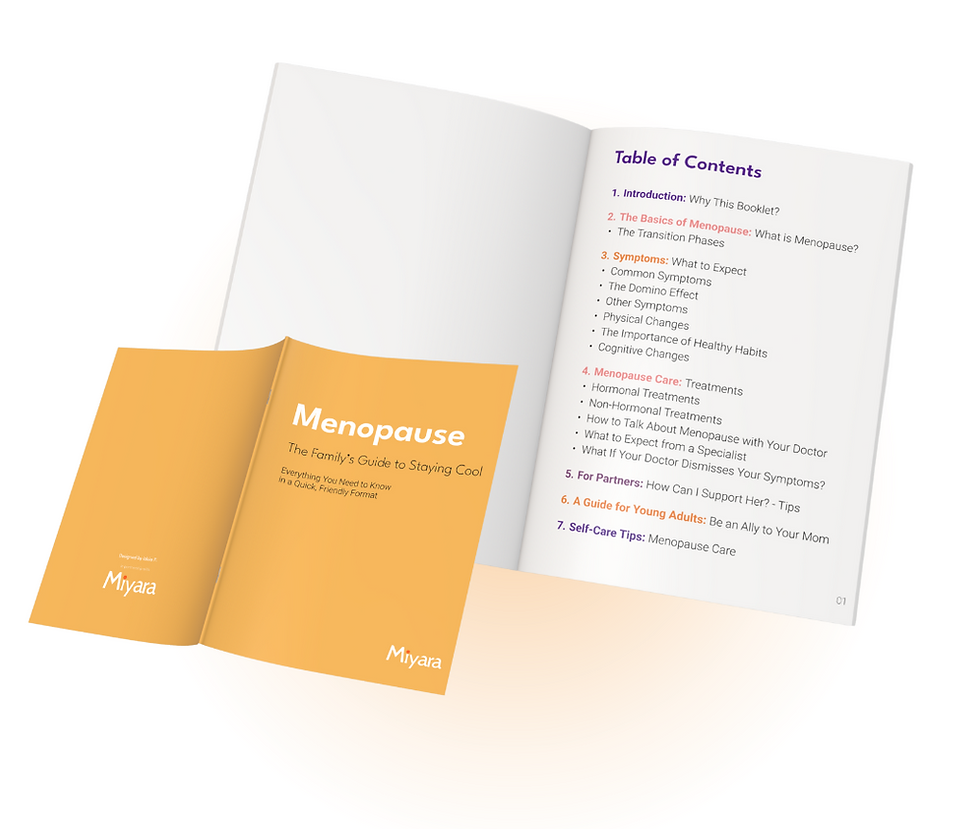
3. Meno Booklet — Physical Interaction Touchpoint 2
This educational booklet breaks down essential menopause information in a way that’s clear, approachable, and easy to share. Based on research insights, it supports women and their families in understanding the journey and preparing for it together.
-
A clear overview of menopause phases
-
Treatment options and lifestyle considerations
-
Practical tips for preparing for healthcare visits
-
A dedicated section for partners and a mini-guide for teenagers to help them support their mothers
It’s designed to empower through knowledge and support better communication within families.
-
The guide is designed to inform, empower, and spark conversation, making it a helpful companion for both personal use and family discussions.
4. The Meno Mindset App
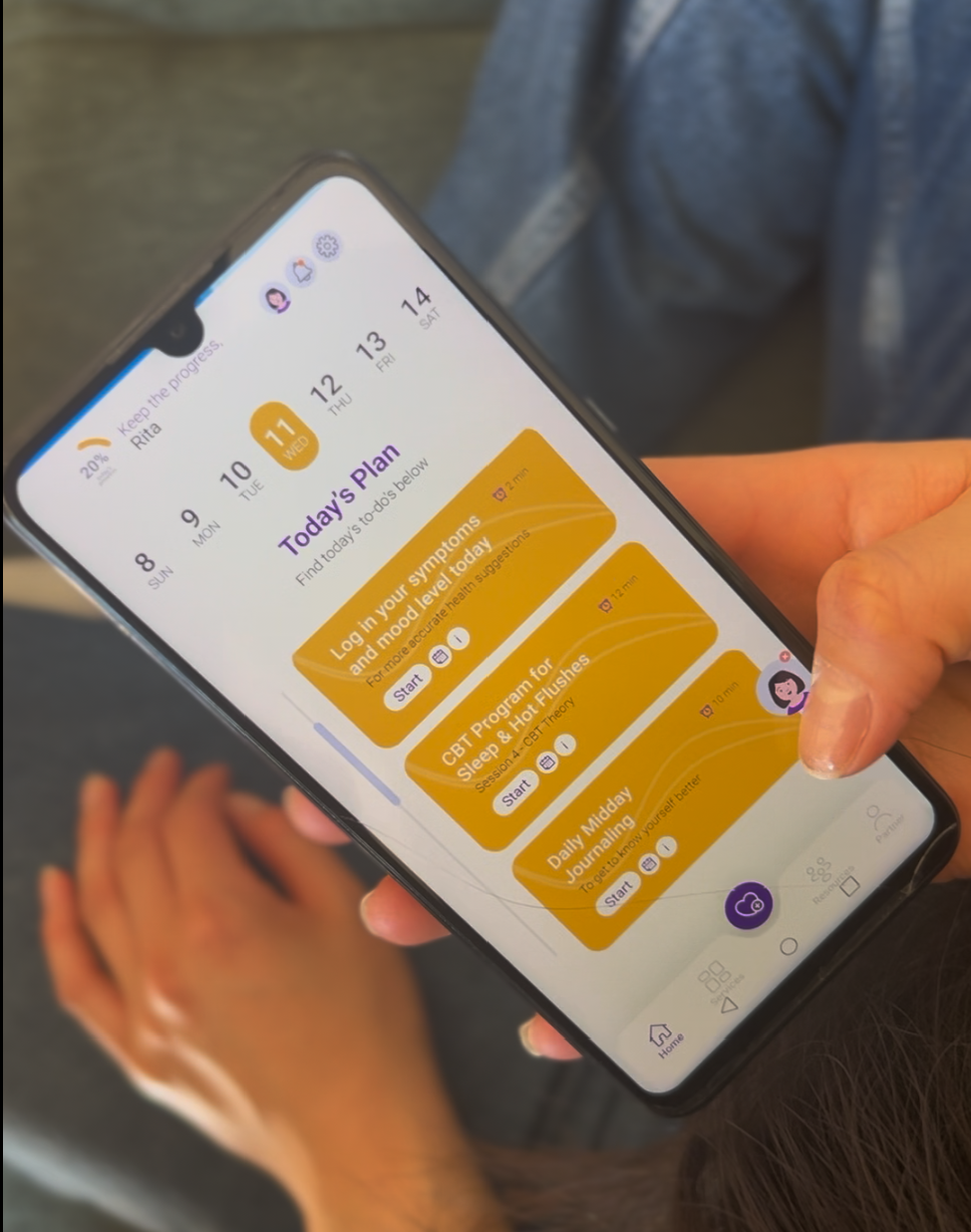
The Meno Mindset App is the digital extension of the toolkit—designed to bring ongoing, personalized support into everyday life. Based on the project’s research and inspired by Miyara Health’s services, two complementary apps were developed:
Focused on symptom tracking, mood journaling, and access to tailored resources. Built on CBT-informed frameworks, it helps users manage physical and emotional changes, stay informed, and feel more in control.
Designed to support understanding and empathy. This app includes bite-sized educational content, conversation tips, and emotional check-ins to help partners show up with clarity and care.
Together, the apps aim to enhance communication, build awareness, and ensure that support doesn’t stop at the clinic or the kitchen table—but continues, thoughtfully, day by day.

Testing
With individual women
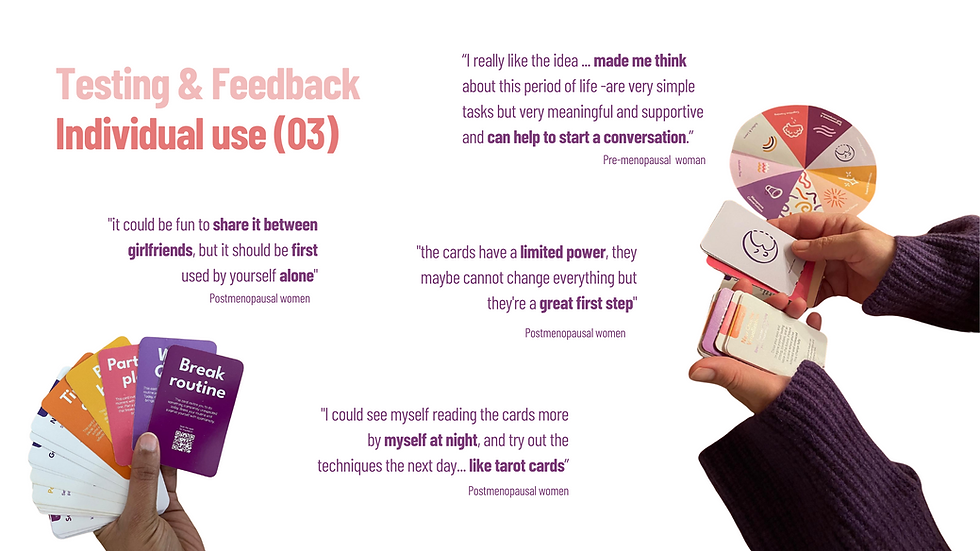
The cards were seen as a helpful first step—something to engage with privately, in quiet moments, similar to how one might use journaling prompts or even tarot cards. While some were open to sharing them later with partners or friends, most preferred starting alone, using the cards to reflect and process their experiences first.

With Couples
The conversations sparked by the cards achieved their goal: opening up dialogue about menopause and women’s health. While some couples were already comfortable with shared reflection, the topic itself felt new and meaningful.
Male partners especially expressed a need for more structure, clear action steps, and guidance on how to better support.
This early feedback, while limited in scale, offered valuable insights for the next iteration—especially in making the toolkit more practical and accessible for shared use.
Reflection
As a woman, daughter, and friend, this project was deeply personal. It began with concern for my own mother, as I watched her navigate menopause with limited support and little information.
Throughout the process, I listened to many stories—some painful, some empowering. The women who managed this transition well had one thing in common: awareness and support. It became clear that while menopause isn’t an illness, it is a major life change that deserves recognition, understanding, and care.
There is still a significant gap in how the healthcare system addresses women’s health, especially during midlife. But if more of us acknowledge the relevance of menopause—not just as a private experience but as a public health issue—we can begin to create a chain reaction of awareness, empathy, and change.
This project starts at home—with tools that support reflection and conversation—but its vision reaches further: toward better healthcare services, more informed support systems, and a more dignified, empowered aging experience for all women.


We generated change!
This project has inspired the people from the municipality of Emmen. They have been working hard to make Emma and our other ideas a tangible reality for their community.
Our project has been seen in action around the Emmen neighborhoods and it has been published in the “Luzerner Zeitung” and the “Emmenmail” journal in Summer of 2023.
Sources:
All pictures were produced only for this project.